Wall Street closes at a record for the first time since end of January

Luxury conglomerate Kering (EPA:PRTP) presented its Q1 2026 financial results on April 14, 2026, revealing a stabilization in revenue performance that sent shares up 2.62% to close at €273.80. The presentation marked a pivotal moment for the French luxury group, with flat comparable revenue growth representing a significant achievement against a backdrop of geopolitical tensions and challenging consumer sentiment.
Executive Summary
Kering reported group revenue of €3,568 million for the first quarter of 2026, representing a 6% decline on a reported basis but remaining flat year-over-year on a comparable basis. The stabilization comes after several quarters of declines and was driven by exceptional performances in the Jewelry and Eyewear segments, which offset continued weakness in the Fashion & Leather Goods division, particularly at flagship brand Gucci.
The company also unveiled a new segment reporting structure designed to reflect strategic priorities, organizing its portfolio into four distinct segments: Fashion & Leather Goods, Jewelry, Kering Eyewear, and Corporate & Other.
Quarterly Performance Highlights
As shown in the following waterfall chart illustrating the revenue bridge from Q1 2025 to Q1 2026, currency headwinds and the disposal of Kering Beauté drove the reported decline while underlying business remained stable.
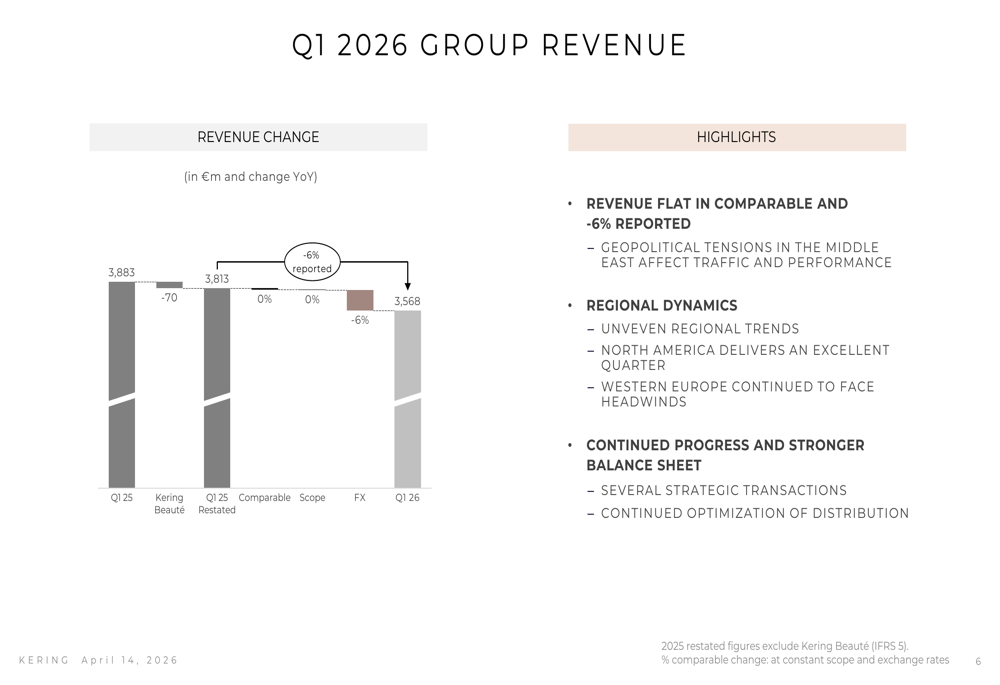
The presentation highlighted several key factors impacting performance, including geopolitical tensions in the Middle East that disrupted retail traffic, uneven regional trends with exceptional North American performance contrasting with Western European headwinds, and ongoing strategic transactions and distribution optimization efforts.
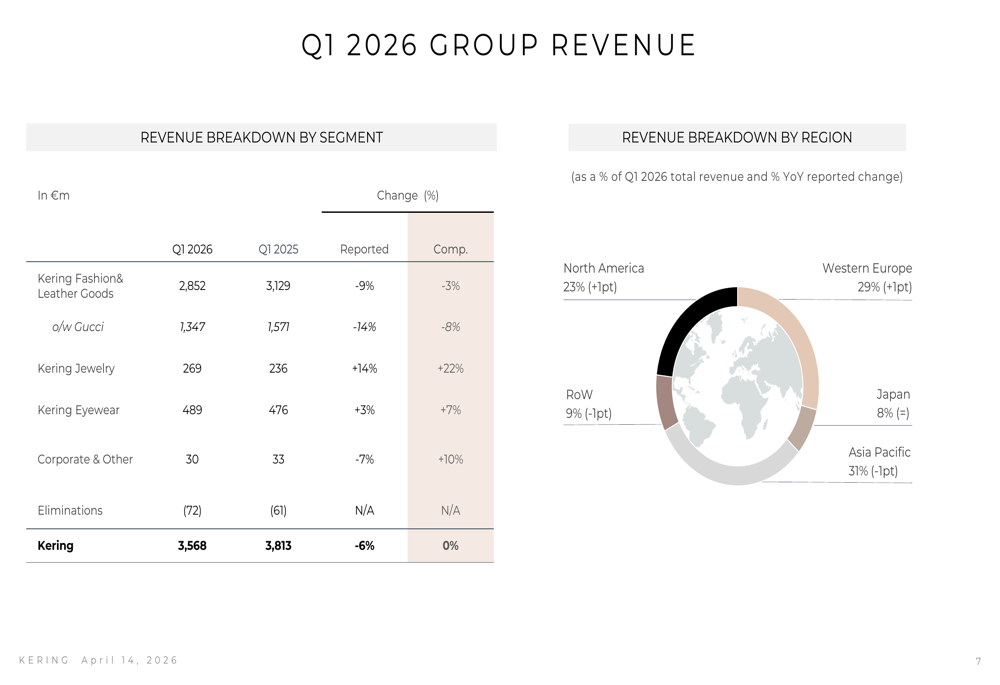
Breaking down performance by business segment, the company’s portfolio showed significant divergence. The Fashion & Leather Goods segment generated €2,852 million in revenue, down 9% on a reported basis and 3% on a comparable basis. Within this segment, Gucci remained under pressure with revenue of €1,347 million, representing a 14% reported decline and 8% comparable decrease.
The following chart illustrates the segment and regional breakdown of Q1 2026 revenue, revealing the geographic concentration and performance disparities across Kering’s portfolio.
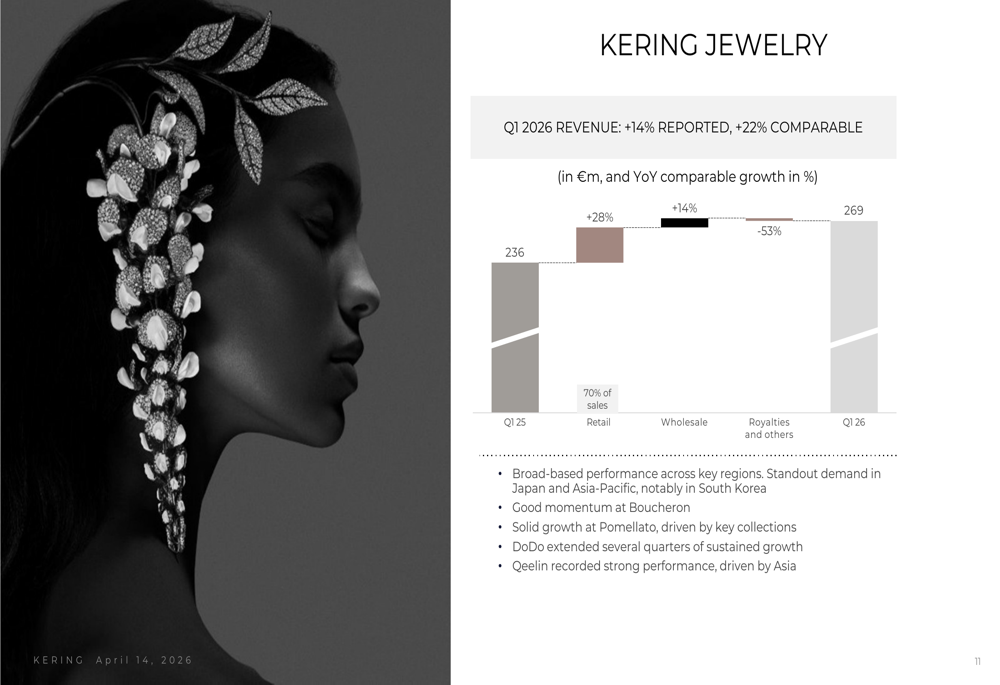
In stark contrast, Kering Jewelry delivered standout results with revenue of €269 million, up 14% on a reported basis and an impressive 22% on a comparable basis. The segment benefited from broad-based performance across key regions, with particularly strong demand in Japan and Asia-Pacific. Boucheron maintained good momentum, Pomellato posted solid growth, DoDo sustained its growth trajectory, and Qeelin delivered strong performance driven by Asian markets.
Kering Eyewear achieved its strongest quarter ever, generating €489 million in revenue, up 3% reported and 7% comparable. The performance was driven by strong demand across the portfolio, high-profile product launches including the first Valentino eyewear collection, and reinforced brand visibility and desirability.
Regional Performance Analysis
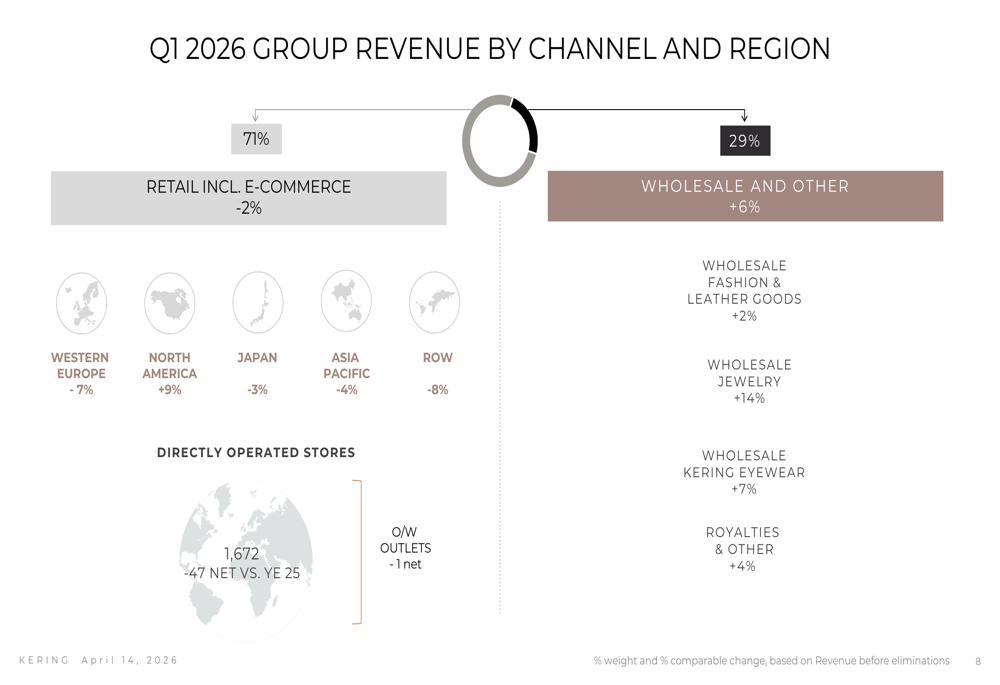
The presentation revealed stark regional disparities in performance. North America emerged as the clear standout, with directly operated store sales up 9% on a comparable basis, accounting for 23% of total group revenue. This strong performance contrasted sharply with Western Europe, which declined 7% and represented 29% of revenue, and Asia-Pacific, down 4% while comprising 31% of the business.
The channel breakdown showed that retail (including e-commerce) accounted for 71% of revenue with a 2% decline, while wholesale and other channels represented 29% of revenue with 6% growth. The company operated 1,672 directly operated stores at quarter-end, representing a net decrease of 47 stores versus year-end 2025, reflecting ongoing distribution optimization.
Strategic Initiatives
The presentation introduced Kering’s new segment reporting structure, which reorganizes the company’s brand portfolio to better reflect strategic priorities and operational focus.
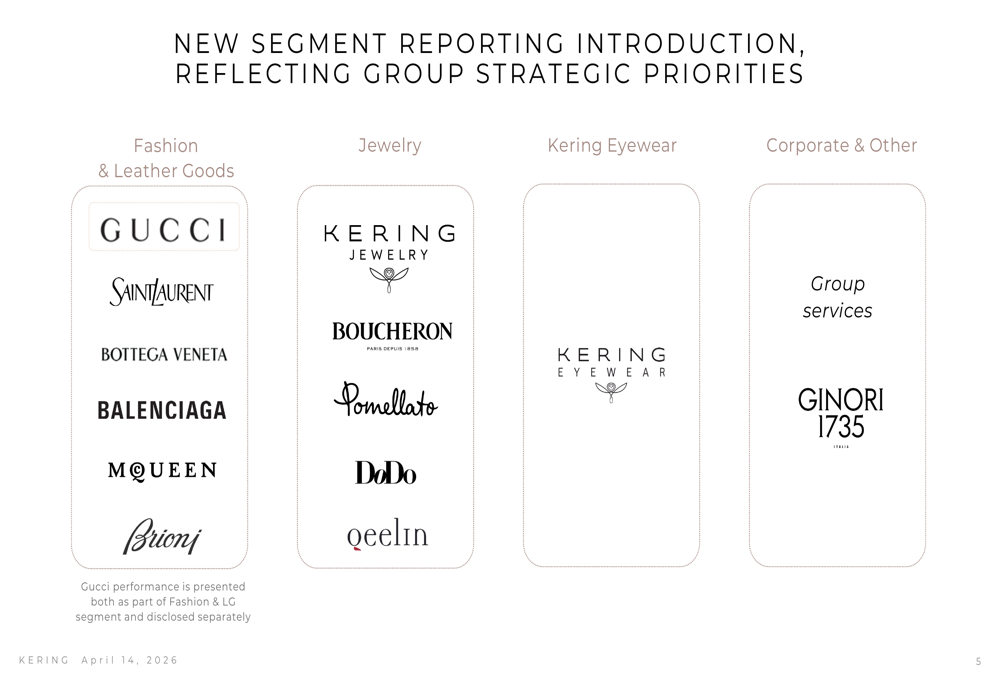
The new structure consolidates Gucci, Saint Laurent, Bottega Veneta, Balenciaga, McQueen, and Brioni under Fashion & Leather Goods; groups Kering Jewelry brands including Boucheron, Pomellato, DoDo, and Qeelin into a dedicated Jewelry segment; establishes Kering Eyewear as a standalone segment; and creates a Corporate & Other category encompassing group services and Ginori 1735.
For the Fashion & Leather Goods segment specifically, the company highlighted strong performances from Saint Laurent and Bottega Veneta, continued growth from Balenciaga, building momentum at Brioni, and ongoing rationalization at McQueen.
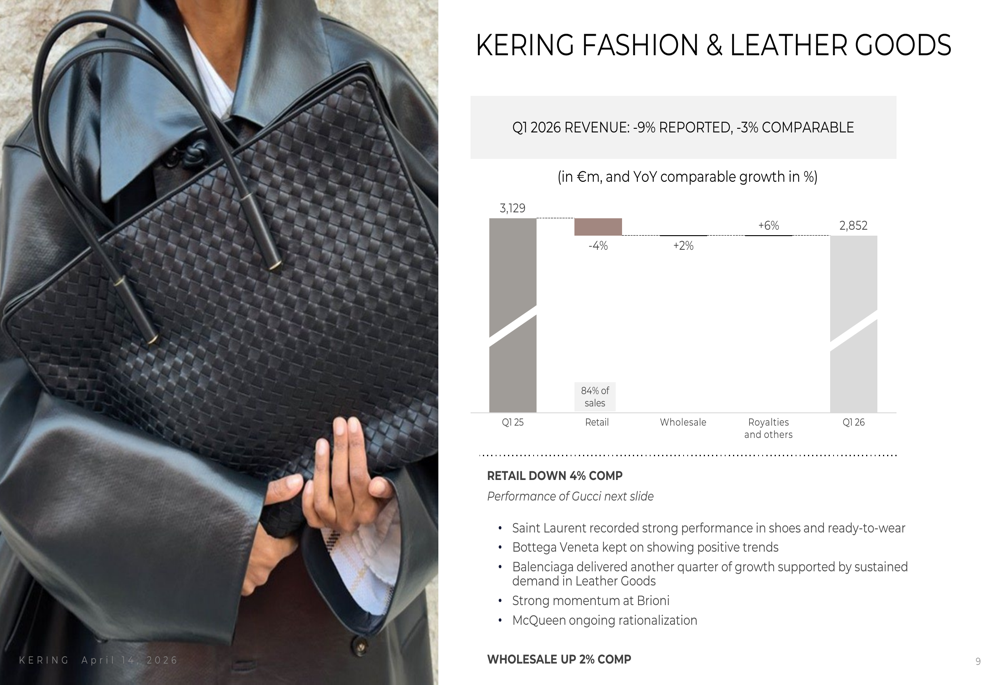
At Gucci, management emphasized good performance in North America offsetting weaker results in Asia-Pacific and Western Europe, with execution focused on refocused product architecture and category priorities. Retail sales declined 9% on a comparable basis while wholesale grew 2%.
Forward-Looking Statements
Looking ahead, Kering’s presentation outlined an outlook for fiscal year 2026 focused on returning to growth and improving margins. The company announced a Capital Markets Day scheduled for April 16, 2026, in Florence, Italy, where management is expected to provide more detailed strategic guidance.
The stock’s positive reaction to the results—rising 2.62% on the day—suggests investors view the revenue stabilization as a meaningful inflection point. The shares have delivered a 64% return over the past year, though some analysts note the stock is currently trading above fair value estimates.
The first quarter results demonstrate Kering’s evolving portfolio dynamics, with emerging strength in Jewelry and Eyewear providing a counterbalance to the ongoing challenges at Gucci and broader Fashion & Leather Goods operations. As the luxury sector navigates macroeconomic uncertainty and geopolitical tensions, Kering’s ability to maintain stable comparable revenue while executing on strategic initiatives positions the company for potential recovery as market conditions improve.
Full presentation:
This article was generated with the support of AI and reviewed by an editor. For more information see our T&C.